
TENJAM
The Case for Outdoor Learning
A white paper on the evidence, design principles, and practice of outdoor learning, across every climate, and different kinds of teaching institutions.
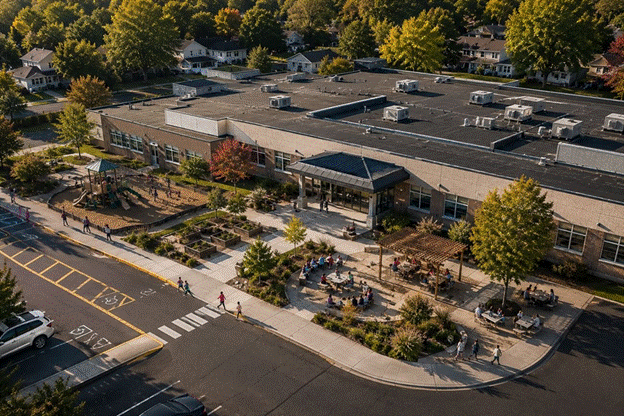
Aerial view of an outdoor learning space integrated into a K-12 campus.
Published by Tenjam | Updated October 2026
Table of Contents
|
|
Executive Summary
The research on outdoor learning is no longer in question. Across dozens of studies, spanning K-12 schools, early childhood programs, and informal learning settings, structured time outdoors produces measurable gains in student engagement, confidence, and wellbeing. Teachers benefit too. So do the communities that build around these spaces.
What remains in question, for most decision-makers, is not whether outdoor learning works. It’s whether it can work here, in a climate that swings from triple-digit heat to sub-zero winters, on a campus never designed with the outdoors in mind, or in an institution that has never thought of itself as a place for outdoor learning at all.
This paper makes the case that the answer is yes, and shows why. It draws on research from North America and abroad to show that climate is a design variable, not a disqualifying condition, naming specific strategies for the two climates that generate the most resistance: extreme heat and hard winters, with Phoenix, Orlando, and Minnesota as working examples of each. It extends the conversation beyond K-12 schools to libraries, museums, and children’s healthcare facilities, each with its own body of evidence for what outdoor space does for the people who use it. And it closes with what the research, the field, and current construction costs all suggest about building outdoor spaces that last and cost a fraction of adding indoor square footage.
The reader in a hurry will find the complete argument in the pages that follow. The reader who wants to go further, into the specific studies, the international models, and the sector-by-sector evidence, will find that in the Research Appendix.
| 147 studies reviewed on nature-specific outdoor learning, finding measurable benefits across academic, social, and wellbeing outcomes Mann et al., Frontiers in Public Health, 2022 |
Introduction: Why This Conversation Matters Now
Ask a school leader, a library director, a museum educator, or a children’s hospital administrator whether time outdoors benefits the people they serve, and the answer is almost always yes. Fresh air. Natural light. A change of environment. These are intuitive goods that don’t need a citation to defend.
Ask whether an outdoor learning space would work at their institution, in their climate, and the conversation changes. “Our summers are unbearable.” “We lose half the year to snow.” “We’re not built for this.” It’s the most common objection to outdoor learning, and it’s a reasonable one. Nobody wants to invest in a space that sits empty five months a year.
This paper exists to answer that objection directly, with evidence rather than enthusiasm. It’s written for people who take their decisions seriously: the school administrator weighing a capital investment, the library board considering a green space renovation, the museum educator building a case for outdoor programming, the hospital planner designing a garden meant to help children heal. Each is asking a version of the same question. Does this work, and will it work for us, in a climate like ours?
The paper is organized in two parts. The core paper, which follows, makes the complete case in roughly twenty minutes: what the research shows about benefits to students, teachers, and communities; how thoughtful design answers the climate objection directly, with specific strategies and named examples for both extreme heat and extreme cold; how the same principles extend to libraries, museums, and healthcare settings; and what the evidence, and current construction costs, suggest about building outdoor spaces that hold up over years, not just seasons, at a fraction of the cost of adding a comparable amount of indoor space.
For readers who want to go further, a Research Appendix follows the core paper. It contains the full international evidence base, including outdoor education traditions from Norway and the United Kingdom that predate this conversation in North America by decades, along with deeper sector-specific research on libraries, museums, and children’s healthcare facilities, a city-by-city climate snapshot, and a complete bibliography.
This paper is the foundation for a broader set of resources. Six Questions to Ask Before You Buy Furniture for Outdoor Learning Spaces takes the durability section of this paper and expands it into a practical buyer’s checklist. It draws on the same research base and can be read on its own or alongside this paper.
Outdoor learning is not a trend. It’s one of the oldest forms of education there is, and the evidence has simply caught up. What follows lays that evidence out climate by climate and sector by sector, so the only question left is not whether outdoor learning works, but how to build it well, and for what it actually costs.
What the Research Shows: Students
The case for outdoor learning doesn’t rest on a single study. It rests on a growing body of research, reviewed and cross-checked by researchers who set out specifically to test whether the enthusiasm around outdoor learning is supported by evidence, and that body of research keeps growing.
The most comprehensive foundational review is a 2022 systematic review published in Frontiers in Public Health, examining 147 studies on nature-specific outdoor learning and its effects on children’s learning and development (Mann et al., 2022). The review found measurable benefits across academic, social, and wellbeing outcomes. It also noted that the underlying research still varies in methodological quality and would benefit from more rigorous study designs going forward. Real benefits, and a call for better evidence: that combination is a more credible position than either uncritical enthusiasm or dismissal, and it’s the position this paper takes throughout.
More recent research reinforces the same conclusion with newer, larger pools of evidence. A 2025 meta-analysis published in Education Sciences pooled 21 studies, spanning 2014 to 2024 and children and adolescents ages 6 to 18, and found a consistent, positive overall effect of outdoor time on mood, anxiety, and interpersonal relationships, with the strongest evidence behind social connectedness specifically (Vasilaki et al., 2025). A 2026 scoping review in Health & Place looked at 22 school-based nature programs for students ages 10 to 18, including school gardening, outdoor education, and conservation work, and found consistent gains in anxiety, self-esteem, resilience, and school connectedness (Lorimer et al., 2026). That review also shows the full picture rather than only the good news: it found the academic evidence specifically, as opposed to the wellbeing evidence, to be mixed, with only small gains in science engagement and arithmetic and little evidence of broader academic benefit. Wellbeing and social outcomes are the strongest, most consistent finding in this body of research. Academic outcomes are real but more variable, and this paper won’t claim otherwise.
A separate systematic review in the International Journal of Environmental Research and Public Health looked specifically at what happens when regular classes are held outdoors, examining learning, social, and health dimensions together (Becker et al., 2017). A third review, published in Career and Technical Education Research, synthesized the broader literature on integrating outdoor learning into K-12 curricula and found consistent, if uneven, evidence for its value across subjects and grade levels (Meighan & Rubenstein, 2018).
Some of the most specific findings involve engagement and cognitive function immediately following outdoor time. A study by Kuo, Browning, and Penner (2018), published in Frontiers in Psychology, directly tested a common teacher worry: that lessons in nature would leave students too keyed up to focus once back indoors. The researchers compared matched pairs of lessons, one outdoors, one indoors, across ten topics in two third-grade classrooms. The finding ran counter to that worry: classroom engagement was consistently higher, not lower, following the outdoor lesson.
The broader research connecting school greenness to measures like sustained attention is mixed. A 2025 study of Belgian schoolchildren, for instance, found that sustained attention was actually higher in more urbanized school environments in that particular sample. “Greener is better” is not a universal finding across every study design, and the full picture includes some real complexity alongside the clearer, more consistent findings on engagement and wellbeing.
None of this research claims outdoor learning is a cure-all, and this paper won’t either. What it claims, and what the evidence supports, is that structured time outdoors is associated with real, measurable benefits for students, across enough independent studies, research teams, and now meta-analyses pooling that work together, that the pattern is hard to dismiss as coincidence.
What the Research Shows: Teachers and Community
Less attention gets paid to what outdoor learning does for the adults who lead it, and for the communities that grow up around it. But the evidence here is real too, and it matters. A space that students benefit from but teachers avoid using will not survive past its first year.
The clearest finding in this area is that teacher confidence, not funding or infrastructure, is often the strongest predictor of whether outdoor learning happens at all. A UK study of the Hampshire Trailblazer project, which supported teachers in moving parts of the curriculum outdoors, found that structured practice and support measurably increased teachers’ self-efficacy and their willingness to teach outside the classroom (Nundy, Dillon, & Dowd, 2009). One teacher in the study, after twenty-two years in the profession, described never having thought to use the outdoor space near the school until the program gave them a reason to try. That shift, from a space nobody thought to use to one that becomes part of normal practice, shows up again and again across the research on outdoor education. The space matters less than the confidence to use it well.
At the community level, a study examining schoolyard greening across Chicago, Amsterdam, and Paris found benefits that extended well beyond the students themselves: stronger community engagement, greater social cohesion, and improved resilience to climate stress (Flax et al., 2020). Behavior mapping conducted after schoolyard greening projects in Chicago found sustained increases in both physical activity and positive social interaction, with teachers reporting reductions in bullying, teasing, and conflict following the change (Children & Nature Network, research digest). Broader research on urban green space consistently links it to increased neighborhood cohesion (Peters, 2010; Jennings & Bamkole, 2019) and lower crime (Wolfe & Mennis, 2012), independent of any specific educational program.
Taken together, this research points to something worth saying plainly: an outdoor learning space is rarely just an educational investment. When it works, it becomes a small piece of civic infrastructure, a place where a school and the community around it overlap. That’s a higher bar than simply installing furniture in a courtyard. It’s also a more accurate description of what a well-used outdoor learning space becomes.
Answering the Climate Objection
If the benefits of outdoor learning are well established, the climate objection is the reason so many institutions stop short of acting on them. It deserves to be taken seriously, not dismissed, because it’s usually raised by people who have thought carefully about their own conditions and concluded, reasonably, that a Minnesota winter or a Phoenix summer makes the whole idea impractical.
The research and the field both point to the same answer: climate is not a disqualifying condition. It’s a design variable. Institutions in genuinely difficult climates, including some of the most extreme in the country, have already worked out what holds up and what doesn’t, and the pattern that emerges is less about extreme engineering and more about a small number of deliberate choices, applied consistently. The next two sections make that case with the specific cities most often raised as the exception: Phoenix and Orlando on the hot end, Minnesota on the cold.
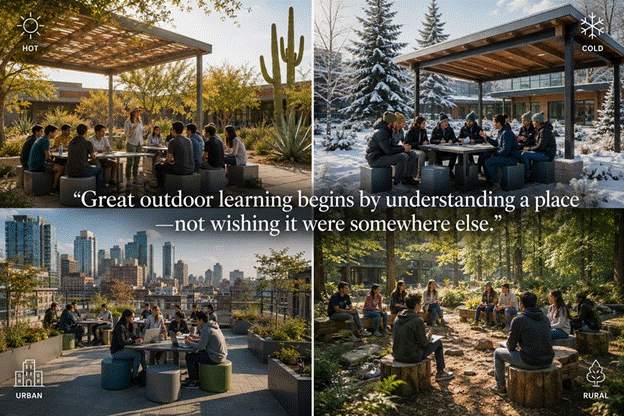
Outdoor learning works across every climate and setting; the design logic changes, the underlying principle doesn’t.
Hot climates: Phoenix and Orlando
In hot climates, the evidence centers on three factors: shade, surface, and timing. A 2017 study conducted in a Lubbock, Texas schoolyard measured the effect of shade directly, using personal monitors on children during physical activity, and found that shade reduced overall solar radiation exposure by 84 percent and UVB exposure by 91 percent (Vanos, McKercher, Naughton, & Lochbaum, 2017). That’s a substantial effect from a single design decision, and it didn’t require synthetic cooling technology, only the placement of shade relative to where children sit.
Phoenix is a useful test case precisely because it’s the city most people assume disqualifies outdoor learning outright. A 2025 study by Arizona State University researchers Allison Poulos and Jennifer Vanos tracked heat exposure, activity, and mood across five Phoenix elementary schoolyards over a six-week period. The findings cut both ways. Only 18 to 28 percent of the schoolyards studied had any shade at all, well below the roughly 30 percent national average, and students were, if anything, more active in full sun than in shade, even though they reported being more comfortable in it. Students were also 71 percent sedentary during ordinary classroom time, and 40 percent more active during gym-based recess and 17 percent more active during outdoor recess than in the classroom (Poulos & Vanos, 2025). Read together, the finding isn’t that Phoenix’s heat makes outdoor time impossible. It’s that most Phoenix schoolyards haven’t yet been designed for the heat they already have, and the schools that have invested in shade see real use of it: one Phoenix principal in the study spent two years raising $80,000 for water fountains and a shade structure, a meaningful sum, and a fraction of what a classroom addition would cost (see the cost discussion later in this paper). By July 2026, with Phoenix reaching 117°F and K-12 absence rates running 16 percent higher on days above 90°F nationally, the same researchers were urging exactly this kind of shade and surface investment as the lower-cost, faster-to-deploy complement to mechanical cooling, not a substitute for it where cooling is already in place (Poulos & Vanos, 2026).
Orlando faces a different version of the same problem: not Phoenix’s dry desert heat, but humid subtropical heat that makes evaporative cooling strategies far less effective. A 2025 Climate Central analysis of the 65 largest U.S. school districts found that 97 percent of Orlando’s public school students, and 92 percent of Tampa’s, attend school in what the analysis defines as an extreme urban heat zone, among the highest shares of any city studied, driven by paved surfaces and thin tree canopy rather than climate alone (Climate Central, 2025). Orange County Public Schools, which includes Orlando, is responding with exactly the design logic this paper describes: playground sunshades now cover more than 100 of its elementary schools, with the remainder scheduled to follow, alongside tinted, double-paned classroom windows, added hydration stations, and recess rescheduled earlier in the day to beat peak heat (Orange County Public Schools, reported 2026). None of that required waiting for a cooler climate. It required treating heat as a design problem with a budget line, the same approach this paper recommends everywhere else.
Surface material compounds the shade effect in both cities: asphalt, concrete, and rubber surfacing absorb and re-radiate heat for hours after direct sun exposure ends, while grass, wood chips, and planted beds don’t (Green Schoolyards America, National COVID-19 Outdoor Learning Initiative). Institutions that combine natural shade, natural ground cover, and morning scheduling, before surfaces have had time to heat up, report outdoor spaces that stay usable through conditions that would otherwise be prohibitive. For institutions ready to invest further, engineered shade structures and overhead fans extend usability at moderate cost. In genuinely arid climates like Phoenix, misting systems, common in desert Southwest public spaces, add evaporative cooling; their effectiveness drops sharply in humid climates like Orlando, where the same moisture just adds to the discomfort, which is precisely why Orlando’s investment has gone toward shade and surface rather than misting.
Cold climates: Minnesota
In cold climates, the pattern is different but just as specific: wind matters more than temperature, ground contact matters more than air contact, and duration matters more than either. Wind protection, whether from a planted berm, a built windbreak, or simply orienting seating so backs face the prevailing wind, can make a day in the 20s functionally usable. Insulated, off-the-ground seating addresses the steady heat loss that makes sitting still in the cold genuinely uncomfortable within minutes, often a bigger factor in whether students want to be outside than the air temperature itself.
Minnesota is one of the most useful cold-climate case studies in the country precisely because its own early-childhood community has been documenting what works. A 2025 University of Minnesota Duluth graduate study surveyed 38 nature-based preschool practitioners and interviewed nine, split between Minnesota and Norway, and found that both groups use the same underlying strategy: start with small steps, gradually extending the time and the cold tolerance children build, rather than treating winter as an on-off switch for outdoor time (Johnson, 2025). A companion practitioner handbook developed from the same research, drawing on 39 Minnesota Early Childhood Outdoors programs, documents the practical mechanics in detail: how to dress for cold-weather play, how to judge when conditions actually warrant staying inside rather than assuming the thermometer alone decides, and how to build children’s own judgment about managing risk and discomfort in the cold (Johnson & Ernst, 2025). One Minnesota practitioner in that research put it plainly: cold-weather play is simply “a part of being in Minnesota,” not an exception to programming, and the researchers found that children’s enthusiasm for it reliably spread to their families, making winter outdoor time more of an asset than a liability for family engagement. Institutions that sustain cold-weather outdoor programming tend to run short, purposeful sessions, often 10 to 20 minutes, paired with an indoor or covered space nearby, rather than trying to replicate a full class period outdoors. For institutions ready to go further, built windbreaks, heavy-duty retractable wind panels engineered to stay flexible in cold temperatures, and semi-enclosed three-season structures extend the usable window into late fall and early spring.
The underlying pattern
What all three cities have in common is that the underlying design logic fits in a sentence: shade and airflow for heat, wind protection and insulation for cold. Executing it well still takes real attention to a specific site, but neither requires the kind of infrastructure investment that only makes sense for institutions with unusually large capital budgets. Both are achievable by institutions willing to start by observing what they already have: existing tree canopy, existing wind patterns, existing structures that could serve as a windbreak, before deciding what to build.
The deeper point applies to every sector this paper covers, not just K-12 schools, and to every climate, not just these three: the climate objection is a design question wearing the costume of a geography problem. Treat it as the former, and it becomes solvable the way any design problem is solvable: through observation, iteration, and a willingness to start smaller than the eventual goal.
| 84% reduction in solar radiation exposure from shade alone, measured directly on children in a Texas schoolyard Vanos, McKercher, Naughton, & Lochbaum, Photochemistry and Photobiology, 2017 |
Beyond the Classroom: Libraries, Museums, and Healthcare Settings
Everything covered so far applies to K-12 schools specifically, but almost none of it is specific to schools. The underlying idea, that structured outdoor time changes the conditions under which people learn, heal, and connect, applies to any institution built around those goals. Three sectors make the point clearly: libraries, museums, and children’s healthcare facilities.
Libraries have quietly become one of the more interesting frontiers in outdoor learning, precisely because they serve a population schools don’t: children who aren’t yet in school, and families looking for something to do together outside of structured programming. Middle Country Public Library in New York built what it calls a Nature Explorium, an outdoor space designed specifically for early-childhood exploration and family learning, and it’s become a widely cited model for what a library can be when it stops treating its front door as the edge of its educational mission. A library’s core function, connecting people with resources and ideas, doesn’t require four walls. An outdoor space extends that function to exactly the population, young children and their caregivers, that benefits most from unstructured, exploratory time outside.
Museums have a longer-standing research tradition to draw on. Education researchers distinguish between formal learning, the kind that happens in a classroom with a curriculum, and free-choice learning, the kind that happens when a person chooses what to engage with, for how long, and at what depth. Museums have always been free-choice learning environments. A landmark 2009 National Research Council report on informal science education found that these self-directed settings produce genuine learning, often with engagement and retention that compares favorably to formal instruction, precisely because the learner is driving the experience. An outdoor space extends a museum’s free-choice model further. It removes the implicit rules of an indoor gallery, quiet voices, controlled movement, look-but-don’t-touch, and replaces them with a setting where exploration can be physical as well as intellectual. For a museum already committed to informal learning as its core method, an outdoor component isn’t an addition. It’s a logical extension of what the institution already believes about how people learn.
Children’s healthcare facilities represent the sector with the deepest and most rigorous research base of the three, because the outcomes being measured, patient stress, recovery time, family wellbeing, are exactly what hospitals already track carefully. The foundational research traces back to Roger Ulrich’s landmark 1984 study, which found that hospital patients with a view of nature recovered faster and required less pain medication than patients facing a brick wall. That finding has been replicated and extended many times since, and it reshaped how healthcare architecture thinks about windows, gardens, and outdoor access. The research on healing gardens specifically has grown more nuanced since then. A 2013 study looking at hospital gardens found that many are built with good intentions but sit underused, and identified what actually predicts whether a garden gets used: visibility from patient rooms, easy access without requiring a staff escort, and design that accommodates medical equipment and mobility limitations rather than assuming an able-bodied visitor (Pasha, 2013). For children specifically, the stakes are higher and the design considerations more particular. A healing garden for a pediatric population needs to account for IV poles, wheelchairs, and anxious siblings, and for the fact that a child’s tolerance for an intimidating environment is lower than an adult’s, at exactly the moment that tolerance is already being tested.
What unites these three sectors, despite how different they otherwise are, is a pattern already established in the K-12 research: an outdoor space’s benefit is not automatic. It depends on whether the space was designed for how people will use it, not just added as an amenity. A library courtyard, a museum’s outdoor gallery, and a hospital’s healing garden all succeed or fail for structurally similar reasons. In every sector, the institutions getting this right are the ones that treated outdoor space as a design problem worth solving carefully, rather than a landscaping decision made after the real planning was finished.
Designing Spaces That Last
An outdoor learning space that works in year one and fails by year three hasn’t actually succeeded. It’s just postponed the disappointment, and it tends to leave behind more skepticism than the institution had before it started. The research on benefits, and the design principles for working with a difficult climate, both assume a space that stays in usable condition long enough for those benefits to accumulate. That assumption depends almost entirely on material choices made early, often without much scrutiny, that quietly determine whether a space is still functioning in five years or has become the reason nobody wants to try this again.
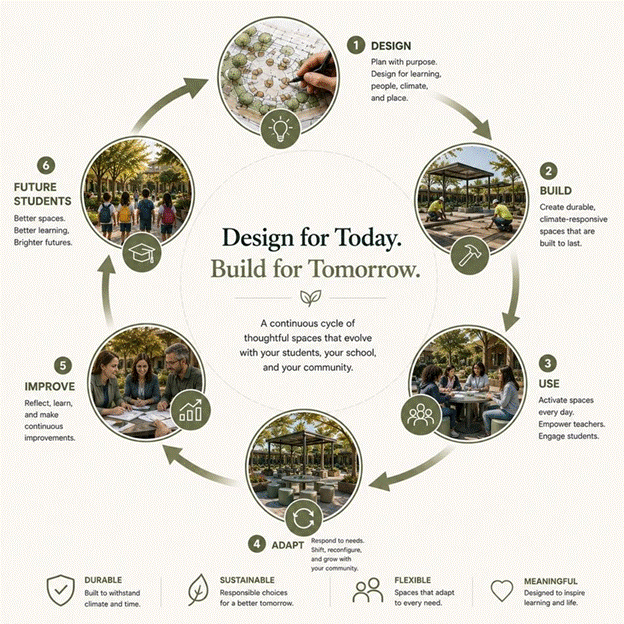
Designing for today, building for tomorrow: outdoor learning spaces succeed when they’re built to evolve, not just to open.
The pattern of failure is remarkably consistent across institutions and sectors. Furniture that stays damp long after rain discourages use in ways that have nothing to do with the underlying educational value of the space, particularly among older students, for whom a visibly wet or dirt-marked seat carries real social cost. Materials that look durable but aren’t, coated steel that rusts once its finish is breached, untreated wood that splits and warps through wet-dry cycles, introduce both a maintenance burden and, eventually, a safety concern. Furniture marketed as sustainable is not automatically low-maintenance: exotic hardwoods often require annual refinishing that can consume four or more labor-hours per table, a cost rarely factored into the initial purchase decision but that determines, in practice, whether a facilities team keeps up with it. And surfaces that can’t function as a genuine work surface, mesh tabletops that lose small components through their gaps being a common example, undermine the educational use case the furniture was meant to support in the first place.
None of this argues for a single correct material or a single correct approach to every piece of furniture in a space. A thoughtful outdoor learning environment typically mixes lightweight, easily moved furniture, useful for flexible group work and easy storage, with more permanent pieces designed to stay anchored and weather-resistant over years. What the research and the field evidence both point to is a smaller, more practical standard: choose materials based on what they’ll look and function like after several years of real use and minimal maintenance, not based on how they look in a rendering or on a showroom floor. The institutions that apply this standard consistently are the ones whose outdoor spaces are still in active use long after the initial excitement has faded, which is, in the end, the only measure of success that matters.
What this costs, compared to expanding the building
The climate objection usually travels with a second, quieter one: even if outdoor learning works, isn’t it easier and more defensible, budget-wise, to just add classroom space instead? The numbers say otherwise, and it’s worth laying them out plainly, with the caveat that an outdoor learning space and a new classroom aren’t identical products. They solve overlapping but not identical problems, and the comparison below is directional, not a line-item substitute for a local quote.
National planning-level data from Gordian’s RSMeans cost database puts new elementary school construction, including green building considerations, at roughly $239 per square foot on average across the country (Gordian, 2024). A single classroom addition sized at 900 to 1,200 square feet, a common size for one classroom, runs somewhere in the neighborhood of $215,000 to $290,000 at that rate, before land, site work, permitting, or design fees are added in. That figure is consistent with what districts generally report when a single-classroom addition comes up at a board meeting.
A well-designed outdoor learning environment, by contrast, typically costs a fraction of that for a comparable or larger footprint. Nature Explore’s published planning budgets, drawn from real outdoor learning environment projects, range from under $30,000 for a modest space under 5,000 square feet built in phases with some volunteer labor, to $60,000 to $100,000 for a mid-sized space of 5,000 to 8,000 square feet, to $100,000 to $150,000 and up for a fully built environment of 8,000 to 10,000-plus square feet (Nature Explore, 2023). That top tier, a fully built-out space several times larger than a single classroom addition, still typically costs less than half what the classroom addition alone would run, and it comes without the ongoing costs of heating, cooling, and maintaining an enclosed structure.
The same logic shows up at a larger scale in the climate-resilience data already discussed in this paper. Researchers studying school heat exposure estimate that installing air conditioning in the roughly 41 percent of U.S. school districts that still need it, or lack it altogether, would cost approximately $40 billion nationally, with updating already-installed but outdated systems adding another $414 million or more. Shade structures sized for a single schoolyard, by comparison, run in the tens of thousands of dollars (Poulos & Vanos, 2026). Making an existing indoor environment genuinely climate-resilient, in other words, is one of the most expensive line items a district can take on. Making an outdoor one climate-resilient, through shade, surface choice, windbreaks, and the right furniture, is a comparatively modest one, and it’s an investment that starts paying off the first season it’s usable rather than waiting for a multi-year capital project to clear a bond vote.
None of this is an argument that outdoor learning space should replace indoor classrooms outright; the two aren’t interchangeable, and this paper isn’t claiming they are. It’s an argument that when the question is where the next marginal dollar of capacity, comfort, or climate resilience should go, a well-designed outdoor learning space is very often the more efficient answer, not the riskier one.
| ~$240 average cost per square foot to build new elementary school space nationally, before land, site work, or design fees Gordian RSMeans Data, 2024 |
None of this replaces local design expertise. Architects, landscape architects, and engineers who know a school’s climate, soils, codes, and campus can turn the principles in this paper into a plan that fits one specific site: where the shade falls, where the wind comes from, how water drains, and what structures need to be engineered for. Institutions get the best results when they bring a local architecture and design firm into the process early, and use furniture and materials that support that design rather than constrain it.
Conclusion: A Call to Action
The evidence in this paper points toward a conclusion that’s almost anticlimactic in its simplicity. Outdoor learning works. Climate is a design problem, not a disqualifying condition, in Phoenix and Orlando as much as in Minnesota. The same underlying logic extends well beyond K-12 schools. Durability is a material choice, not a matter of luck. And done well, it typically costs a fraction of what the equivalent indoor square footage would. None of these claims required speculation. Each rests on research that’s been reviewed, replicated, or field-tested by institutions that took the question seriously enough to measure the results.
What separates the institutions that succeed with outdoor learning from those that don’t is rarely resources. It’s usually the willingness to treat the outdoor space as a real design problem, worthy of the same scrutiny given to any other capital investment, rather than as an inspirational add-on to figure out later. That willingness is available to a small rural elementary school and a large urban children’s hospital alike, in a desert climate and an arctic one, in a K-12 district and a public library.
Tenjam has spent years working alongside schools, and increasingly libraries, museums, and healthcare facilities, on exactly this problem: how to design outdoor spaces, and the furniture within them, that hold up to real climates, real budgets, and real years of use. This paper shares what that work, and the broader research it draws on, has taught us. For readers who want to go further into the specific studies, the international models this paper only touched on, and the sector-by-sector evidence, the Research Appendix that follows has all of it. For a practical guide to furniture material choices, see Six Questions to Ask Before You Buy Furniture for Outdoor Learning Spaces.
The question in front of most institutions is no longer whether outdoor learning is worth pursuing. It’s whether they’re willing to design for it carefully enough, for their specific climate and their specific budget, to make it last. The best first step is a conversation with a local architecture and design firm that knows your site and your climate.
Research Appendix
For readers who want to go further: the international evidence base, sector deep-dives, a city-by-city climate snapshot, and complete bibliography.
A. The International Evidence Base
North America is a relative latecomer to structured outdoor learning. Norway and the United Kingdom, among other countries, have decades of practice and research behind approaches that most U.S. and Canadian institutions are only now beginning to formalize. Understanding what these models show, and where the comparison to North American conditions breaks down, is useful for any institution trying to gauge how far to take its own outdoor learning program.
Norway and the Nordic Tradition
Outdoor learning in Norway isn’t a program layered onto an existing curriculum. It’s closer to a cultural default, rooted in the concept of friluftsliv (pronounced roughly FREE-loofts-leev), roughly translated as “open-air life.” The term describes a broader Scandinavian relationship to time spent outdoors that predates any specific educational theory. Norwegian early-childhood education reflects this directly: outdoor kindergartens (barnehage with substantial or exclusive outdoor time) are a mainstream, unremarkable option for Norwegian families, not a niche alternative.
Research on this model has generally supported it, with appropriate nuance. A study by Moser and Martinsen (2010), surveying 117 Norwegian kindergartens, documented just how central outdoor time is in practice: children spent an average of 70 percent of their kindergarten day outdoors in summer and 31 percent in winter, in institutions with outdoor areas averaging roughly 2,600 square meters. These findings establish outdoor time as a structural feature of Norwegian early childhood education, not an occasional supplement. More recent work has taken a wider regional view: a scoping review by Remmen and Iversen (2022), examining 52 empirical studies across all five Nordic countries, found that research on outdoor education in the region is more often qualitative than quantitative, concentrated in primary schools, and, notably, more focused on teachers’ perspectives than on any other single theme. Even within a region often treated as a single outdoor-education model, both the practice and the research about it are far from uniform.
A direct link between the Nordic and Minnesota research discussed in the core paper’s cold-climate section is worth drawing out here: the 2025 University of Minnesota Duluth study of nature preschool practitioners (Johnson, 2025) deliberately interviewed practitioners in both Minnesota and Norway, and found that both groups converge on the same practical approach to winter, starting with small steps and building tolerance gradually, despite very different institutional histories. That convergence is independent evidence that the design and practice principles in this paper’s cold-climate section aren’t culturally specific to Scandinavia. They work the same way in the American Midwest.
What North American institutions can reasonably take from the Nordic model is the underlying premise: outdoor time doesn’t have to be an occasional supplement to indoor learning, treated as a field trip or a special unit. It can be the default mode of operating, with indoor time filling a complementary role instead of the other way around. What doesn’t translate directly is the infrastructure and cultural context behind it. Nordic countries have built outdoor-ready clothing norms, childcare staffing ratios, and public expectations around outdoor time that took generations to establish, and no single school or district can replicate that context through a single capital investment. The lesson from Norway is less “build exactly this” and more “outdoor time at this scale is achievable when a society decides it’s normal,” a slower, more cultural argument than a purely architectural one, though as the Minnesota research shows, that cultural shift is already well underway in at least one American state.
The United Kingdom and Forest Schools
The UK’s Forest School movement offers a different, more directly transferable model, because it developed as an add-on to an existing, conventional school system rather than as a foundational cultural practice. Forest School programs typically involve regular, structured sessions in a wooded or naturalized outdoor setting, led by trained practitioners, with a strong emphasis on child-led exploration and risk-appropriate play.
The research base here has matured considerably. A systematic review by Sella, Bolognesi, Bergamini, Mason, and Pazzaglia (2023), published in Educational Psychology Review, examined 16 studies (a combined 1,560 children) comparing forest-school and indoor-school preschoolers. Forest-school children showed higher benefits across cognitive function, motor coordination and balance, and connectedness to nature, though the review explicitly flags that the underlying studies remain methodologically heterogeneous enough that a full meta-analysis wasn’t yet possible, a limitation worth noting, not a reason to dismiss the findings. A separate study by Hepworth, Haddad, and Edmonds (2024) tracked 151 UK schoolchildren aged 7-8 across a 12-week Forest School program and found participants rated themselves as less tired, less bored, calmer, and happier than a classroom control group, with greater improvements in cooperative behavior as well. The foundational case-study work in this area, a 2007 study by O’Brien and Murray published in Urban Forestry & Urban Greening, documented specific, observable changes in participating children across multiple English Forest School sites: increased confidence, improved social skills, and greater motivation and concentration.
The UK experience also surfaces an important, less celebrated finding: teacher confidence, not the availability of outdoor space, is often the actual bottleneck. As discussed earlier in this paper, the Hampshire Trailblazer research (Nundy, Dillon, & Dowd, 2009) found that structured teacher support measurably increased willingness to use outdoor space that had, in some cases, sat unused for years. A related literature review on outdoor teaching in initial teacher training found a consistent pattern across multiple studies: hands-on practice during teacher training reliably increases self-efficacy and confidence in outdoor instruction, more reliably than theoretical coursework alone. The practical implication for any institution building an outdoor learning program, in any country, is that the furniture, the shade structure, and the windbreak solve only part of the problem. Without deliberate investment in staff confidence, a well-designed outdoor space can sit underused for the same reason a Forest School-caliber woodland sat unused for twenty-two years: nobody felt equipped to be the first to use it.
What Transfers, and What Doesn’t
Both the Nordic and UK models reinforce the same conclusion this paper has argued from the K-12 research forward: climate is not the limiting factor. Norway’s climate is colder than nearly anywhere in the continental United States attempting outdoor learning, and the UK’s is wetter and greyer than the reputation of “bad weather” as a disqualifying condition would suggest. What both models share, and what actually explains their success, is sustained institutional commitment: consistent staff training, cultural buy-in, and enough time for outdoor practice to become normal rather than exceptional.
For a North American institution starting from a different baseline, cold or wet weather without an existing culture of outdoor time, the lesson from these two models isn’t to import a specific program wholesale. It’s to recognize that the same two levers, staff confidence and design that respects local conditions, that made Norway’s and the UK’s outdoor learning succeed are available to any school, library, museum, or hospital willing to invest in both, including those already doing it in Minnesota today.
| 70% / 31% of the kindergarten day spent outdoors in Norway, summer and winter respectively, across 117 kindergartens surveyed Moser & Martinsen, European Early Childhood Education Research Journal, 2010 |
B. Sector Deep-Dive: Libraries
Public libraries occupy an unusual position in the outdoor learning conversation: they serve populations that schools, by definition, cannot, most notably children below school age and their caregivers, along with adults and families looking for informal, unstructured engagement rather than a curriculum. That difference matters for how an outdoor library space should be understood, and evaluated.
Middle Country Public Library, on Long Island, New York, is the most frequently cited example of a library taking this seriously. Its Nature Explorium was built specifically as an outdoor early-childhood learning environment, and it’s been widely referenced in library-sector literature as a model for what a library can be when its educational mission is treated as extending past its own doors. The underlying premise is straightforward: a library’s core function is connecting people with resources, ideas, and each other, and none of that inherently requires an indoor setting. An outdoor space that supports exploration, caregiver-child interaction, and early literacy activities is arguably closer to a library’s mission than a distant analogy would suggest.
The broader research on green space and community outcomes supports the case for why this matters beyond any single library’s program. A review of the relationship between social cohesion and urban green space found consistent evidence across the literature that shared outdoor space contributes to stronger neighborhood ties, more informal social contact, and greater community resilience, effects that aren’t specific to libraries but that a library, as one of the few remaining truly free, no-appointment-necessary public institutions, is unusually well positioned to deliver (Jennings & Bamkole, 2019). A related research agenda published through the University of California Press has argued specifically that green, outdoor educational space is inequitably distributed, concentrated in wealthier areas and wealthier school districts, and that public institutions like libraries have a particular opportunity, and arguably an obligation, to extend access to nature-based learning to communities that would otherwise not have it (Children & Nature Network research agenda, 2020).
What the library sector’s evidence base doesn’t yet have, compared to K-12 education or healthcare, is a large body of outcomes research specific to library outdoor spaces themselves, measuring, for instance, literacy gains or long-term family engagement attributable to an outdoor library program. Worth stating plainly rather than glossing over: the case for library outdoor space currently rests more on adjacent research (the K-12 evidence, the general green-space-and-community-cohesion research, and strong practitioner case studies like Middle Country) than on a dedicated body of library-specific outcome studies. That’s a real gap, and it’s also an opportunity. A library willing to invest in an outdoor learning space and document what happens is positioned to contribute genuinely new evidence to a body of research that could use it.
C. Sector Deep-Dive: Museums and Informal Learning
Museums have a research advantage the library and healthcare sectors don’t share to the same degree: a mature, decades-old academic field dedicated specifically to understanding how people learn in exactly the kind of self-directed, exploratory settings that outdoor space naturally creates.
The relevant concept is free-choice learning, a term used throughout the museum education and informal-science-education literature to describe learning that happens when a person chooses what to engage with, for how long, and at what depth, as opposed to formal learning, which follows an externally imposed curriculum and sequence. A landmark 2009 report from the National Research Council, Learning Science in Informal Environments, synthesized decades of research on museums, science centers, and similar settings and concluded that free-choice learning environments produce genuine, measurable learning, often with engagement and retention that compares favorably to formal instruction, precisely because the learner’s own motivation is driving the experience. This isn’t a fringe or emerging claim. It reflects a broad academic consensus built up over a long research tradition, further developed in subsequent work including chapters in the Cambridge Handbook of the Learning Sciences addressing informal and museum-based learning specifically.
The relevance to outdoor space is direct, if slightly indirect in the existing literature. Museums have always operated as free-choice learning environments indoors; the research establishing why that model works doesn’t change when the setting moves outdoors, and in some respects, the argument strengthens. An indoor gallery still carries implicit behavioral rules, quiet voices, controlled movement, minimal physical interaction with exhibits, that constrain the free-choice model even as they serve legitimate conservation and safety purposes. An outdoor space removes many of those constraints, allowing exploration to be physical as well as intellectual, in a way that’s arguably more consistent with the free-choice learning philosophy museums already claim to practice indoors.
What the literature doesn’t yet offer, and what would strengthen this section considerably if it existed, is a substantial body of research measuring outcomes specific to outdoor museum spaces as distinct from the broader free-choice learning research developed primarily around indoor galleries and exhibits. Museums with strong outdoor components, botanical gardens, zoos, and science centers with outdoor exhibit areas among them, offer compelling practitioner examples. But a rigorous, dedicated research base connecting outdoor museum space specifically to the learning outcomes the free-choice literature documents indoors remains an area where the field is still catching up to practice.
D. Sector Deep-Dive: Children’s Healthcare Facilities
Of the three sectors covered in this appendix, children’s healthcare facilities have the deepest and most methodologically rigorous research base, for a straightforward reason: hospitals already measure the outcomes that matter (recovery time, medication use, patient and family stress) as a matter of clinical routine, which makes it possible to study the effect of outdoor access with a level of precision that education and library research rarely achieve.
The foundational study is Roger Ulrich’s 1984 research, published in Science, which found that hospital patients recovering from surgery in rooms with a view of nature had shorter postoperative stays, required significantly less pain medication, and received more favorable nurse evaluations than comparable patients whose rooms faced a brick wall. This finding has been replicated and extended many times in the decades since, and it fundamentally reshaped how healthcare architecture approaches windows, gardens, and outdoor access, moving nature access from an aesthetic nicety to a factor with a measurable clinical effect.
More recent research has focused less on whether nature access helps, which is now well established, and more on why some healing gardens get used heavily while others, despite significant investment, sit largely empty. A 2013 study examining barriers to garden visitation in children’s hospitals found that usage was predicted less by the garden’s size or design sophistication than by three practical factors: visibility from patient rooms and common areas, so patients and families are reminded the space exists and see others using it; ease of access, meaning a garden reachable without requiring a staff escort or navigating a confusing route; and accommodation of medical equipment and mobility limitations, since a beautifully designed garden that can’t accommodate an IV pole or a wheelchair effectively excludes the population most likely to need it (Pasha, 2013). A broader literature review on therapeutic hospital gardens reinforces this pattern across studies: the gardens with the strongest usage and outcome data are consistently the ones designed around real patient constraints, not the ones with the most elaborate landscaping.
The pediatric context adds considerations that don’t apply to general hospital populations. Children’s tolerance for an unfamiliar or intimidating environment is generally lower than an adult’s, and that tolerance is often already depleted by the reason they’re in the hospital in the first place. A 2023 literature review by Din, Russo, and Liversedge, published in the journal Land, focused specifically on healing gardens for children and recommended design considerations including open spaces that support varied play, clear wayfinding, accessible pathways, sensory-rich planting, movable seating, and space for both open activity and quiet retreat, elements that don’t necessarily arise from adult-focused garden design. A broader 2023 literature review by Nieberler-Walker, Desha, Bosman, Roiko, and Caldera, published in HERD: Health Environments Research & Design Journal, reinforces the same underlying pattern across the wider hospital garden literature: the gardens with the strongest usage and outcome data are consistently the ones designed around real patient constraints, not the ones with the most elaborate landscaping.
Taken together, the pediatric healthcare research offers perhaps the clearest illustration in this entire paper of a principle that applies everywhere outdoor learning space is built: good intentions and real budget are not sufficient. The difference between a healing garden that works and one that sits empty is almost entirely a matter of design decisions made with genuine attention to how the specific population will use the space.
E. City-by-City Climate Snapshot and Full Design Reference
The core paper’s climate section covers the essential design logic for hot and cold climates, anchored in Phoenix, Orlando, and Minnesota. This section adds the more granular detail relevant to an institution actually planning a build, rather than deciding whether to start, along with a short snapshot of what each named city’s own data shows.
Phoenix, Arizona
- Average student heat exposure from the built environment adds roughly 7.3°F above baseline, the lowest added-heat figure among the 65 large cities studied by Climate Central, because the surrounding desert baseline is already hot; the problem in Phoenix isn’t urban heat island effect on top of mild weather, it’s genuinely extreme ambient heat layered on top of whatever urban heat exists (Climate Central, 2025).
- Only 18 to 28 percent of schoolyards studied in a 2025 Phoenix-area research project had any shade coverage at all, against a roughly 30 percent national average (Poulos & Vanos, 2025).
- July 2026 reached 117°F in Phoenix; the same researchers report that K-12 absence rates nationally run 16 percent higher on days above 90°F, and that an estimated 41 percent of U.S. school districts with air conditioning need to update or replace it (Poulos & Vanos, 2026).
- Design implication: dry heat and intense direct sun make shade orientation and surface material the two highest-leverage interventions; misting systems are genuinely effective in this specific climate in a way they are not in humid cities.
Orlando, Florida
- 97 percent of Orlando’s public school students attend school in an extreme urban heat zone, the third-highest share among the 65 cities studied, driven by paved surfaces and thin tree canopy (Climate Central, 2025).
- Orange County Public Schools has installed playground sunshades at more than 100 of its elementary schools, with the remainder scheduled to follow, alongside tinted double-paned windows, added hydration stations, and recess moved earlier in the day (Orange County Public Schools, reported 2026).
- Design implication: humidity sharply reduces the effectiveness of evaporative cooling strategies that work well in Phoenix, so Orlando’s own investment has gone toward shade, surface, and scheduling rather than misting, a useful signal for any humid-climate institution evaluating the same tradeoff.
Minnesota
- A 2025 University of Minnesota Duluth study of 38 nature-based preschool practitioners in Minnesota and Norway found both groups rely on the same core strategy: starting with small steps and gradually building children’s tolerance and comfort in the cold, rather than treating winter as disqualifying (Johnson, 2025).
- A companion practitioner handbook drawing on 39 Minnesota Early Childhood Outdoors programs documents specific, field-tested practices for dressing, judging conditions, and managing cold-weather risk (Johnson & Ernst, 2025).
- Design implication: in Minnesota’s climate, the limiting factor is consistently wind and ground contact, not air temperature alone; insulated, off-the-ground seating and a built windbreak do more for usable days per year than any amount of added square footage.
Hot climate specifics (general):
- Shade orientation matters as much as shade coverage. A structure or canopy positioned to block late-morning and early-afternoon sun, when UV intensity and heat both peak, provides more benefit than the same square footage of shade positioned for morning or evening sun.
- Surface temperature differences between materials can be dramatic even in identical sun conditions. Dark asphalt and rubber surfacing can reach temperatures 40 to 60 degrees Fahrenheit higher than adjacent grass or mulched surfaces on a hot, sunny day, affecting both comfort and, at the extreme, burn risk for young children in contact with the surface.
- Airflow, not just shade, affects perceived temperature substantially. A shaded space with no airflow can still feel oppressive; positioning a space to take advantage of natural cross-breezes, or supplementing with fans where structures allow, meaningfully changes usability even without any change in ambient temperature.
- Hydration access should be treated as part of the design, not an afterthought. Outdoor spaces used in hot climates benefit from proximity to a water source, reducing the friction that keeps students or visitors from staying hydrated during outdoor time.
Cold climate specifics (general):
- Wind direction should be assessed on-site, not assumed. Prevailing wind patterns vary by microclimate, and a windbreak positioned based on general regional wind data rather than actual on-site observation can miss the mark entirely.
- Solar gain remains useful in cold climates and is sometimes underused. A cold-climate outdoor space positioned to receive direct winter sun, rather than shaded as a hot-climate space would be, can extend comfortable use significantly, since direct sun exposure raises perceived temperature even when air temperature stays low.
- Ground-level cold is often underestimated relative to air temperature. Insulated seating addresses this directly, but site selection also matters: areas with standing water or poor drainage tend to ice over and become both uncomfortable and unsafe well before air temperature alone would suggest.
- Salt exposure from winter de-icing affects material selection specifically in cold climates, as discussed in the core paper’s furniture section; this is a climate-specific consideration that doesn’t arise in warm-climate planning at all.
Across all climates, the field evidence consistently favors starting with a smaller, well-executed space over an ambitious space that tries to solve every seasonal challenge at once. Institutions that begin with a modest, well-shaded or well-sheltered area, prove it out with real usage over a season or two, and expand from there tend to end up with spaces that match actual use patterns, rather than spaces designed around an idealized use case that never quite materializes.
F. Complete Bibliography
The citations below are organized by topic. Each was traced to its primary source. Entries that are practical guidance, industry data, or research summaries rather than peer-reviewed studies are labeled as such.
Outdoor learning outcomes, general (K-12)
- Mann, J., Gray, T., Truong, S., Brymer, E., Passy, R., Ho, S., Sahlberg, P., Ward, K., Bentsen, P., Curry, C., & Cowper, R. (2022). Getting Out of the Classroom and Into Nature: A Systematic Review of Nature-Specific Outdoor Learning on School Children’s Learning and Development. Frontiers in Public Health, 10, 877058.
- Vasilaki, M.-M., Zafeiroudi, A., Tsartsapakis, I., Grivas, G.V., Chatzipanteli, A., Aphamis, G., Giannaki, C., & Kouthouris, C. (2025). Learning in Nature: A Systematic Review and Meta-Analysis of Outdoor Recreation’s Role in Youth Development. Education Sciences, 15(3), 332. https://doi.org/10.3390/educsci15030332 [the authors note very high heterogeneity across the pooled studies, so the overall effect size should be read as suggestive rather than precise]
- Lorimer, J., Menon, S., Polgreen, K., Wilhelm, K., & Singh, I. (2026). A Scoping Review of Nature-Based Programmes in Schools for Mental Health and Wellbeing in Young People. Health & Place, 100, 103704. https://doi.org/10.1016/j.healthplace.2026.103704 [published online November 2025 ahead of its 2026 volume]
- Becker, C., Lauterbach, G., Spengler, S., Dettweiler, U., & Mess, F. (2017). Effects of Regular Classes in Outdoor Education Settings: A Systematic Review on Students’ Learning, Social and Health Dimensions. International Journal of Environmental Research and Public Health, 14(5), 485.
- Meighan, H.L., & Rubenstein, E.D. (2018). Outdoor Learning into Schools: A Synthesis of Literature. Career and Technical Education Research, 43(2), 161–177.
- Kuo, M., Browning, M.H.E.M., & Penner, M.L. (2018). Do Lessons in Nature Boost Subsequent Classroom Engagement? Refueling Students in Flight. Frontiers in Psychology, 8, 2253. https://doi.org/10.3389/fpsyg.2017.02253
- Aerts, R., Van Calster, H., Ozen, M., et al. (2025). Green space at school and attention in primary school children in Belgium: A stratified matched case-control study. Urban Forestry & Urban Greening, 105, 128680. https://doi.org/10.1016/j.ufug.2025.128680 [note: findings are more complex than a simple “greener is better” result; see discussion in main text]
Heat, shade, and climate design
- Vanos, J.K., McKercher, G.R., Naughton, K., & Lochbaum, M. (2017). Schoolyard Shade and Sun Exposure: Assessment of Personal Monitoring During Children’s Physical Activity. Photochemistry and Photobiology, 93(4), 1123–1132.
- Poulos, A., & Vanos, J. (2025, August 4). Helping elementary school kids stay active, even in the heat [research summary]. ASU News, Arizona State University. [university research summary of a six-week Phoenix schoolyard study, part of the ASU-led HeatReady Schools initiative; not a peer-reviewed journal article]
- Poulos, A., & Vanos, J. (2026, July 27). It’s getting hotter in classrooms and on playgrounds — schools aren’t ready to handle extreme temperatures. The Conversation. [research commentary by the same ASU researchers; cost and absence-rate figures are attributed by the authors to GAO, NCES, and heat-health research cited within the piece]
- Climate Central. (2025, June 25). Schools and Urban Heat. Climate Matters. climatecentral.org [data journalism/applied-research report, not a peer-reviewed journal article; methodology adapts the Sangiorgio et al. (2020) urban heat island model to 65 large U.S. school districts using 2022-23 NCES enrollment data]
- Green Schoolyards America, National COVID-19 Outdoor Learning Initiative. Strategies for Managing Hot Weather; Strategies for Managing Cold Temperatures; Schoolyard Design and Infrastructure. greenschoolyards.org [practical guidance, not peer-reviewed]
Teachers and community
- Nundy, S., Dillon, J., & Dowd, P. (2009). Improving and encouraging teacher confidence in out-of-classroom learning: the impact of the Hampshire Trailblazer project on 3–13 curriculum practitioners. Education 3–13, 37(1), 61–73.
- Flax, L., Korthals Altes, R., Kupers, R., & Mons, B. (2020). Greening schoolyards: an urban resilience perspective. Cities, 106, 102890. https://doi.org/10.1016/j.cities.2020.102890
- Children & Nature Network. Research Digest: Green Schoolyards – Community and Environmental Benefits. childrenandnature.org [secondary source, aggregates multiple primary studies]
- Peters, K. (2010). Being together in urban parks: Connecting public space, leisure, and diversity. Leisure Sciences, 32(5), 418–433.
- Jennings, V., & Bamkole, O. (2019). The Relationship between Social Cohesion and Urban Green Space: An Avenue for Health Promotion. International Journal of Environmental Research and Public Health, 16(3), 452.
- Wolfe, M.K., & Mennis, J. (2012). Does vegetation encourage or suppress urban crime? Evidence from Philadelphia, PA. Landscape and Urban Planning, 108(2-4), 112–122.
International evidence: Norway and the Nordic region
- Moser, T., & Martinsen, M.T. (2010). The outdoor environment in Norwegian kindergartens as pedagogical space for toddlers’ play, learning and development. European Early Childhood Education Research Journal, 18(4), 457–471. https://doi.org/10.1080/1350293X.2010.525931
- Remmen, K.B., & Iversen, E. (2022). A scoping review of research on school-based outdoor education in the Nordic countries. Journal of Adventure Education and Outdoor Learning, 23(4), 433–451. https://doi.org/10.1080/14729679.2022.2027796
International evidence: United Kingdom and Forest Schools
- O’Brien, L., & Murray, R. (2007). Forest School and its impacts on young children: Case studies in Britain. Urban Forestry & Urban Greening, 6(4), 249–265.
- Sella, E., Bolognesi, M., Bergamini, E., Mason, L., & Pazzaglia, F. (2023). Psychological benefits of attending Forest School for preschool children: A systematic review. Educational Psychology Review, 35, 29.
- Hepworth, A., Haddad, H., & Edmonds, C.J. (2024). Attending 12 weekly sessions of Forest School sessions improves mood and cooperation in 7–8-year-old children. Journal of Adventure Education and Outdoor Learning, 25(4), 899–918. https://doi.org/10.1080/14729679.2024.2393130
Cold-climate practice: Minnesota and Norway
- Johnson, E.K. (2025). Outdoor learning in cold weather: A study of nature preschools’ policies, practices and procedures [Plan B project, Master of Environmental Education]. University of Minnesota Duluth. https://hdl.handle.net/11299/277440 [a graduate capstone project, not a peer-reviewed journal article, based on 38 questionnaire responses and 9 interviews across Minnesota and Norway]
- Johnson, E.K., & Ernst, J. Flourishing in Winter: Guidance for Cold-Weather Play by and for Early Childhood Practitioners. University of Minnesota Duluth, in partnership with the Natural Start Alliance. [a practitioner handbook drawing on 39 Minnesota Early Childhood Outdoors programs, not a peer-reviewed journal article]
Museums and informal learning
- National Research Council. (2009). Learning Science in Informal Environments: People, Places, and Pursuits. Washington, DC: The National Academies Press.
- Crowley, K., Pierroux, P., & Knutson, K. (2014). Informal Learning in Museums. In R.K. Sawyer (Ed.), The Cambridge Handbook of the Learning Sciences (2nd ed., Chapter 23). Cambridge University Press. https://doi.org/10.1017/CBO9781139519526.028
Children’s healthcare facilities
- Ulrich, R.S. (1984). View through a window may influence recovery from surgery. Science, 224(4647), 420–421.
- Pasha, S. (2013). Barriers to Garden Visitation in Children’s Hospitals. HERD: Health Environments Research & Design Journal, 6(4), 76–96.
- Din, S.K.J., Russo, A., & Liversedge, J. (2023). Designing Healing Environments: A Literature Review on the Benefits of Healing Gardens for Children in Healthcare Facilities and the Urgent Need for Policy Implementation. Land, 12(5), 971. https://doi.org/10.3390/land12050971
- Nieberler-Walker, K., Desha, C., Bosman, C., Roiko, A., & Caldera, S. (2023). Therapeutic Hospital Gardens: Literature Review and Working Definition. HERD: Health Environments Research & Design Journal.
Cost and construction data
- Gordian. (2024, February 22). K-12 school construction costs for 2024 [RSMeans Data]. Building Design + Construction. [industry cost-estimating data, not peer-reviewed research; square-foot models are intended for early planning and budgeting, not detailed estimates, and figures vary by region]
- Nature Explore. (2023). Nature Explore planning and budget guidance [follow-up documents]. natureexplore.org [practical guidance, not peer-reviewed; budget tiers are self-reported program guidance, not an independent cost study]
Every citation above was traced to its primary source. Entries that are practical guidance, industry data, or research communications rather than peer-reviewed studies are labeled as such.
The classroom has never been defined by four walls.
The opportunity has always been beyond them.

PUBLISHED BY TENJAM
“Fresh Air Fuels Fresh Thinking.”
— Tenjam